Basketball Betting Glossary: Every Term UK Punters Need to Know
 Available in US

I once spent twenty minutes on a forum thread watching two bettors argue about a “steam move” — one was certain it meant the line had moved sharply in one direction, the other insisted it referred to the public money percentage. They were both half right and half wrong, which is the perfectly normal state of sports betting terminology. The jargon in this industry evolved independently on opposite sides of the Atlantic, and UK punters who learned from American content often carry around a mixed vocabulary that creates confusion exactly when clarity matters most.
This glossary covers the terms you will encounter across strategy discussions, odds comparisons, and data tools — with notes on where UK and US usage diverges. It is not exhaustive, but everything here is something you will need at some point.
Core Betting Terms from A to Z
ATS (Against The Spread) — The result of a game measured against the point spread rather than the outright winner. If a team wins by seven points but was favoured by ten, they lost ATS. An ATS record of 35-15 over a season is a meaningful performance metric; an outright win-loss record of the same team tells you far less about betting value.
Backdoor Cover — When a team covers the spread by scoring late points that do not affect the final result of the game but cross the spread threshold. A team down 20 with two minutes left might score a garbage-time basket that pushes the margin from -14 to -12, covering a -11.5 spread. This happens more than you would expect, and it is extremely aggravating to be on the wrong side of it.
Closing Line — The final odds offered by a bookmaker immediately before an event begins. The closing line is widely regarded as the most accurate probability estimate the market produces, because it incorporates the maximum amount of available information. Comparing your bet price to the closing line is a key way to measure whether you are getting value — see CLV below.
CLV (Closing Line Value) — The difference between the odds at which you bet and the closing line. If you backed a team at 2.10 and the line closed at 1.85, you achieved positive CLV — you got a better price than the final market price. CLV is the single best predictor of long-term profitability in sports betting. Bettors who consistently achieve positive CLV tend to be profitable over large samples even if their short-term results are variable.
Cover — When a team beats the point spread. If a team is favoured by six and wins by nine, they covered. Covering and winning are not the same thing — a team can lose the game outright and still cover the spread if the margin of defeat is smaller than the spread.
Dime — US term for a $1,000 bet. You will encounter this in American content but it has no direct UK equivalent. In UK punting contexts, bettors typically discuss stakes in pounds with no special terminology for specific amounts.
Fade — Betting against a team, public consensus, or trend. “Fading the public” means betting the opposite side of whatever the majority of recreational bettors are backing. This is sometimes a viable strategy when public money has moved a line beyond its true value.
Handle — The total amount of money wagered on a given game or market. High-handle games (major NBA matchups, playoff games) tend to have more efficient pricing because more money and more sharp attention has flowed through the market.
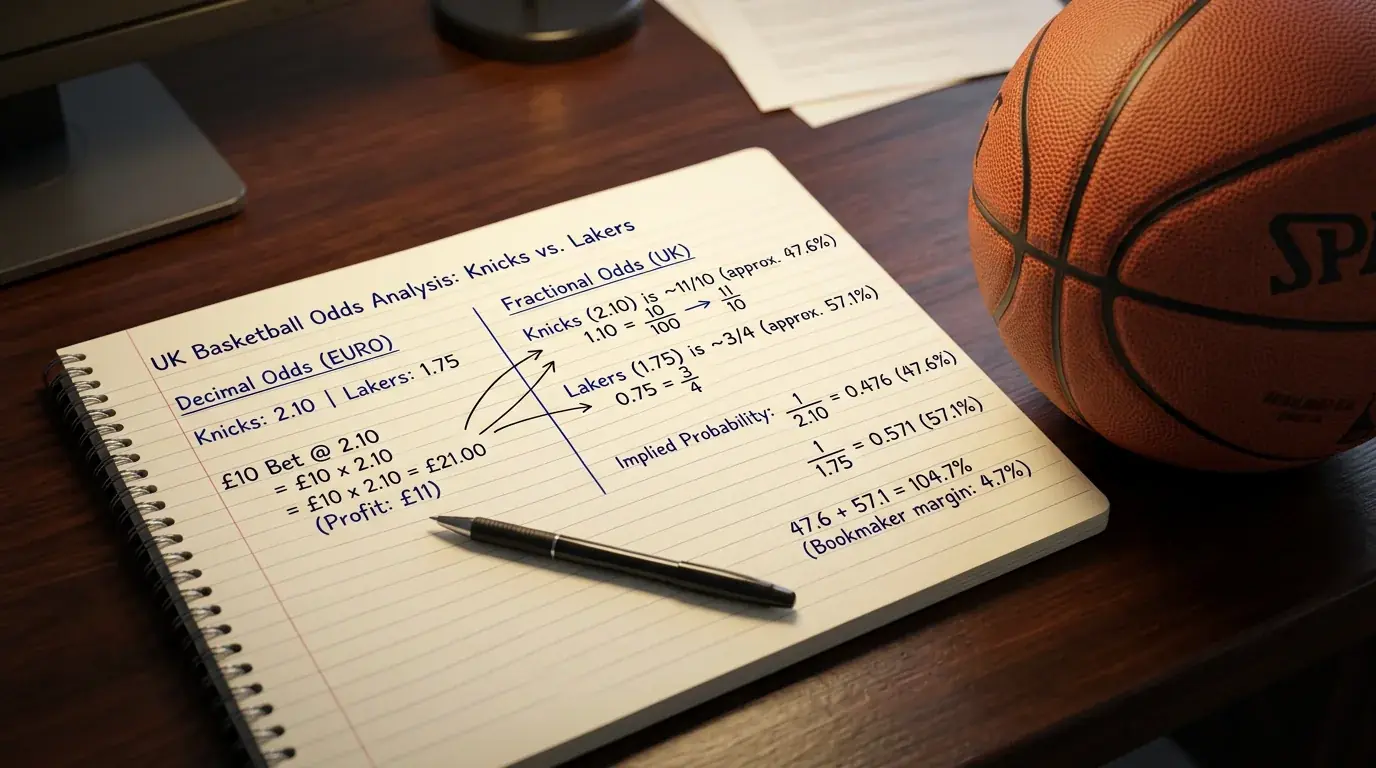
Juice / Vig (Vigorish) — The bookmaker’s commission built into every line. On a standard NBA spread at -110 odds (American) or 1.909 decimal, both sides of the bet carry a margin that ensures the bookmaker profits regardless of outcome if action is balanced. In UK decimal odds, the vig is the gap between what both sides imply in probability (which sums to more than 100%) and 100% itself. A typical NBA spread carries about 4-5% vig.
Key Numbers — Point margins at which NBA games frequently end. Unlike American football where 3 and 7 are critical, basketball’s key numbers cluster around margins of 5, 6, 7, 10, and 12 — though these are less dominant than in football due to basketball’s higher-scoring nature. Half-point differences around these numbers (6 vs 6.5, for instance) carry meaningful value.
Line / Spread — The point handicap applied to a game to equalise betting action. “The line is -5.5 on the Lakers” means the Lakers are favoured by 5.5 points. Bettors who back the Lakers need them to win by six or more; bettors who back the opponent need them to lose by five or fewer (or win outright).
Moneyline — A straight bet on which team wins, with no point spread involved. Odds adjust to reflect the probability — a heavy favourite will have low decimal odds (1.30, 1.40), while an underdog might be priced at 3.50 or higher. In UK contexts, “match result” or “outright winner” are sometimes used interchangeably with moneyline.
Opener — The first line posted for a game, typically released a day or more before tip-off. Openers are set by market-making bookmakers to attract initial action and are often less sharp than the closing line because they have been exposed to less information and less money.
Parlay / Accumulator — A single bet combining two or more selections, where all selections must win for the bet to pay out. The odds multiply across selections, producing larger potential returns but dramatically lower probability. In the US this is universally called a parlay; in the UK, “accumulator” or “acca” is the standard term for the same structure.
Pick ’em / Pick — A game where neither team is favoured — the spread is effectively zero. Both sides are priced approximately equally on the moneyline, subject to the bookmaker’s margin. These games are listed as “PK” on some US odds boards.
Prop (Proposition Bet) — A bet on a specific outcome within a game, typically a player performance metric. NBA props include points scored, rebounds, assists, three-pointers made, and combination markets. Props markets are generally less efficient than game lines, creating more frequent pricing errors for attentive bettors.
Push — When the final margin exactly equals the spread, resulting in a refund of the stake. If a team is favoured by seven and wins by exactly seven, all bets on that game push. This is why half-point spreads (6.5, 7.5) are common — they eliminate the possibility of a push.
Reverse Line Movement (RLM) — When a line moves in the opposite direction to the majority of public betting percentages. If 70% of tickets are on Team A but the line moves in favour of Team B, it indicates that sharp, high-stakes money is driving the movement despite the public consensus. RLM is one of the cleaner signals that sophisticated bettors use to identify where the sharp money is landing.
Sharp / Square — A sharp bettor is a professional or highly skilled individual whose action bookmakers take seriously and whose bets influence line movement. A square is the opposite — a recreational bettor whose action bookmakers welcome because it tends to be less informed. Neither term is absolute; the same bettor can make sharp and square decisions on different days.
Steam Move — A rapid, significant line movement triggered by coordinated sharp action — typically multiple sharp accounts betting the same side simultaneously across multiple bookmakers. Steam moves are visible to observers as sudden, large line shifts that happen almost simultaneously across the market. Getting on before or during a steam move can be valuable; chasing it after it has happened usually is not.
Total / Game Total — A bet on the combined score of both teams, expressed as an over/under. If the total is set at 226.5 and you back the over, you need the combined final score to exceed 226 points. Totals are influenced by pace of play, defensive ratings, injury reports, and situational factors like back-to-back schedules.
Unit — A standardised bet size used to track performance without revealing absolute stake amounts. Most professionals define one unit as 1% of their total bankroll. Tracking results in units rather than pounds allows meaningful comparison across different bankroll sizes and prevents the common mistake of comparing nominal returns without accounting for stake variation.
Value — The condition where the odds offered imply a lower probability than you estimate the true probability to be. A bet at 2.50 (40% implied probability) on an outcome you assess at 48% true probability has value — regardless of whether it wins in the short term.
UK-Specific Terms to Know
British bookmaking developed its own vocabulary largely independent of American sports betting, and some terms you will encounter on UK platforms have no American equivalent — or mean something slightly different.
Accumulator / Acca — The UK standard term for what Americans call a parlay. “Accumulator insurance” is a promotion offered by many UK bookmakers where your stake is refunded (as a free bet) if one leg of a qualifying acca loses. The specific qualifying conditions vary widely between operators.
Best Odds Guaranteed (BOG) — A promotion common in horse racing where the bookmaker pays out at the starting price if it is higher than the price at which you bet. This rarely applies to NBA or basketball markets but is worth knowing as a concept since some UK platforms offer similar guarantees on selected sports at specific times.
Cash Out — The option to settle a bet before the event concludes, at a price calculated by the bookmaker based on current probability. Cash out on NBA games is available in-play at most major UK platforms. The price offered is almost always slightly unfavourable relative to the true probability — bookmakers build a margin into cash out offers the same way they do with opening lines.
Each Way (E/W) — Primarily a horse racing term. In basketball contexts, “each way” has no meaningful application and you will rarely if ever see it offered on NBA markets.
SP (Starting Price) — The official odds at the time an event begins. In horse racing, SP is the benchmark price. In basketball, the equivalent concept is the closing line. When UK bettors say “I got on at a better SP,” they typically mean they bet early at a price more favourable than where the market closed.
Punt / Punter — Standard UK vocabulary for placing a bet and the person who places bets. Completely equivalent to “bet” and “bettor” in American usage. “Punting on basketball” simply means betting on basketball; it carries no additional connotation of recklessness as the word “punt” sometimes does in American football contexts.
Understanding the vocabulary of this market is foundational, not decorative. When you read that a team has a strong ATS record on the road against back-to-back situations, or that sharp RLM suggests the line is moving away from the public consensus, you need to parse that immediately and act on it. The terms above are the working language of the edge you are trying to find. If you want to explore how these concepts apply in practice across the full range of NBA markets, basketball betting markets guide connects the terminology to real strategic applications.
What does ATS mean in basketball betting?
ATS stands for ‘Against The Spread.’ It refers to a team’s record when measured against the point handicap rather than the outright result. A team that is 30-10 ATS has covered the spread in 75% of their games — meaning they either won by more than the spread required, or lost by less than the spread allowed. ATS records are more useful than win-loss records for evaluating betting performance because they account for the line.
What is the difference between juice and vigorish?
There is no difference — they are two names for the same thing. Vigorish (often shortened to ‘vig’) is the older term, derived from Yiddish slang. ‘Juice’ is a more casual American equivalent. Both refer to the bookmaker’s built-in commission that ensures they profit when action is balanced on both sides of a market. In UK decimal odds, the vig is visible as the gap between the sum of both sides’ implied probabilities and 100%.
Prepared by the Basketball Betting Strategies editorial staff.