NBA Value Betting: How to Find Mispriced Odds Before the Market Corrects
 Available in US

Early in my betting career I made the same mistake most punters make. I’d watch a game, pick a winner, and then just take whatever odds were on offer. I was right about the result more often than I was wrong, and I still finished most months down. It took me an embarrassingly long time to understand why.
The answer has nothing to do with picking winners. It has everything to do with price. A bet at 2.10 on an outcome that has a true probability of 55% is a profitable bet over time. The exact same outcome at 1.70 is a money-losing bet over time, even if you win it nine times in a row. That’s the entire philosophy of value betting in a single paragraph, and once it clicks, your whole approach to NBA markets shifts completely.
What Implied Probability Actually Tells You
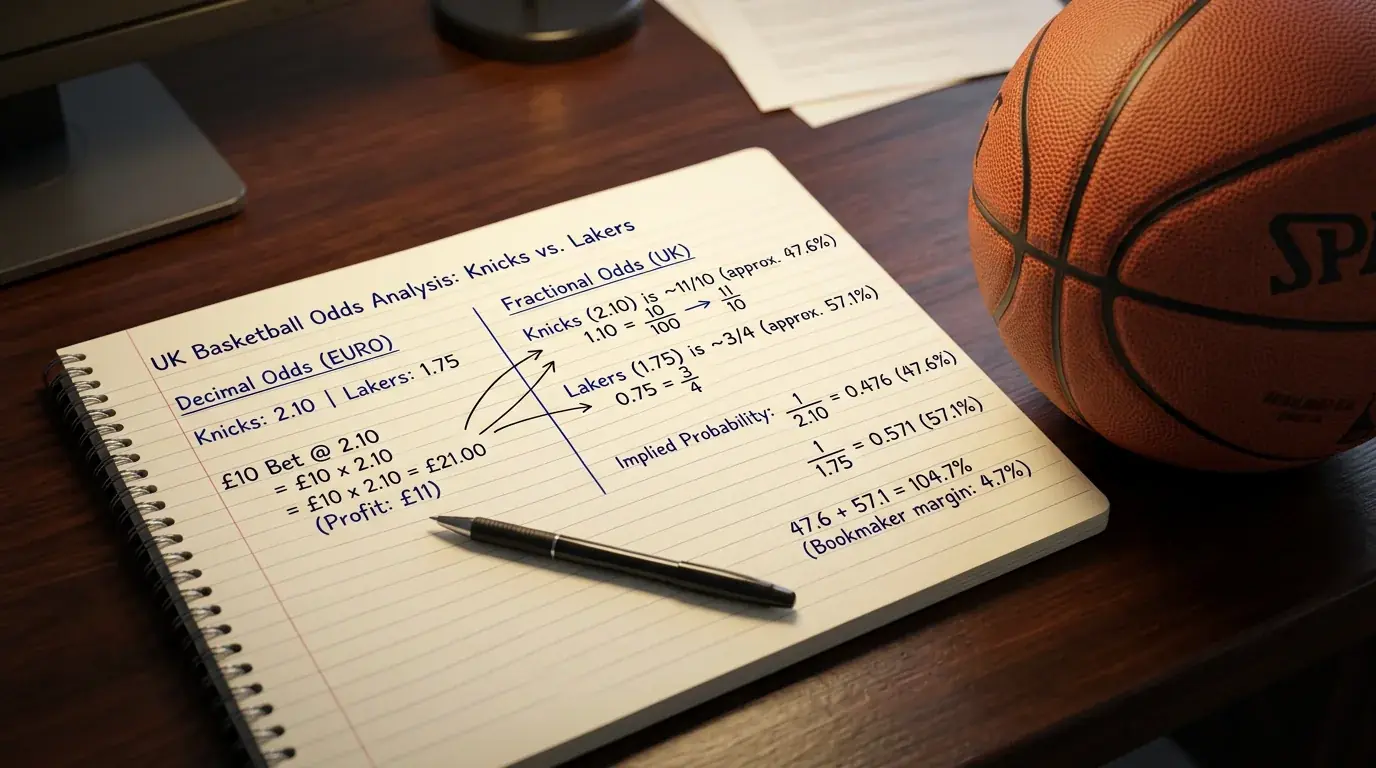
Every decimal odds number you see at a UK bookmaker is a statement about probability, whether the bookmaker intends it that way or not. Converting odds to implied probability is the foundational skill of value betting, and the maths is straightforward: divide 1 by the decimal odds.
Odds of 2.00 imply a 50% probability. Odds of 1.80 imply 55.6%. Odds of 3.50 imply 28.6%. The moment you start reading odds as probability statements rather than payout multipliers, you’re thinking about markets the way sharp bettors do.
The complication is the bookmaker’s margin, also called the overround or vig. If you add up the implied probabilities of both sides of a standard NBA moneyline, the total will be somewhere around 105% to 110%, not 100%. That excess percentage is the bookmaker’s built-in edge. It means that even if you bet randomly on every game, you’re losing roughly 5% to 10% of your stake over time. Value betting is the discipline of identifying spots where the bookmaker has mispriced one side enough that your edge exceeds their built-in margin.
Take a simple example. You assess the Cleveland Cavaliers as having a 58% chance of winning at home against a mid-table Eastern Conference side. The bookmaker has them priced at 1.80, which implies 55.6%. Your probability estimate and the bookmaker’s probability estimate disagree by 2.4 percentage points. That gap is your potential edge. It doesn’t guarantee profit on any single bet — variance is part of the game — but back that type of edge consistently across hundreds of bets and the maths works in your favour.
How to Build Your Own Probability Estimates
The honest answer is that there’s no single clean method, and anyone who tells you otherwise is selling something. What I use is a blend of three inputs: recent team performance measured by point differential, situational context like rest days and travel, and historical market behaviour in comparable matchups.
Point differential is the most underrated starting point. A team’s win-loss record is what gets discussed on television, but point differential — how much they’re winning or losing by on average — is a far better predictor of true quality. A 12-14 team that’s been losing close games while playing a brutal schedule is not the same as a 12-14 team that’s been getting blown out regularly. The odds might be identical. The value is very different.
Once you have a baseline from performance data, you layer in situational factors. Is this a back-to-back for the home team? Are there key injury absences not yet fully priced in by the market? Is this early in the season when small samples create bigger mispricings? Each of these factors adjusts your probability estimate up or down.
Your final number is a rough estimate, not a precise forecast. The goal isn’t perfection — it’s to identify when your estimate differs meaningfully from what the bookmaker is implying. A gap of 3 percentage points or more is worth taking seriously. A gap of 1 percentage point might just be noise.
VSiN’s analytics desk has put it well: success in betting professional basketball requires a blend of traditional scouting and advanced analytics. Neither approach alone is sufficient. Pure stats miss the texture of what’s happening in a locker room. Pure intuition misses what the data can see.
Closing Line Value: The Best Measure of Long-Term Edge
Here’s the single most useful concept I can pass on to any punter trying to build a serious NBA betting approach: closing line value, or CLV.
The closing line — the final odds a bookmaker offers before a game starts — is the most accurate price the market produces. Professional bettors, syndicates, and sharp money have all had their chance to push the line in the direction of true probability. The closing line is, in effect, the market’s best collective estimate of what should happen.
CLV measures whether the odds you obtained were better or worse than where the line closed. If you bet the Golden State Warriors at 1.95 and the market closed at 1.75, you captured positive CLV. If you bet them at 1.95 and the line moved out to 2.20, you had negative CLV — you were on the wrong side of where informed money went.
Why does this matter? Because over a large sample, consistently capturing positive CLV is the single best predictor of long-term profitability. It means you’re systematically getting better prices than the final market consensus. Your individual results will bounce around due to variance, but if your CLV is positive across hundreds of bets, you’re doing something right.
Tracking CLV is simple in practice. Record the odds you took when you placed the bet, then record the closing odds after the game. Keep a running average. If your average CLV is flat or negative after a hundred bets, you’re not finding real value — you’re just gambling at normal market prices and hoping to get lucky. If it’s consistently positive, you have an edge.
The practical implication for timing is significant. Bet early when you believe the line is mispriced and sharp money hasn’t yet corrected it. The NBA market is liquid and efficient for major matchups, but less so for lower-profile games mid-week or for alternative markets like player props. Those are often the best hunting grounds.
Where Value Actually Lives in NBA Markets
The myth is that value is rare and exotic. The reality is that value is episodic — it tends to cluster around specific types of situations rather than appearing randomly.
Public betting percentages are one of the most reliable signals. When a large majority of tickets are on one side, bookmakers shade their lines to balance exposure, which can create artificially inflated odds on the other side. The Pickswise editorial team described this clearly: NBA public betting can be very useful for individual bettors because sportsbooks adjust their odds to keep their books balanced, and staying ahead of that curve could help you net bigger profits. The opportunity isn’t fading the public blindly — it’s recognising when public sentiment has pushed a line beyond what the underlying probability justifies.
Injury news is another recurring source of value, particularly in the hours before game time. When an injury is confirmed late, the market reprices quickly, but it doesn’t always reprice accurately. The immediate reaction tends to overcorrect on the popular side and undercorrect on the less-followed side. If you have a view on how a specific absence affects team performance — not just “they’re missing a starter” but specifically what it does to their defensive rotations or offensive load — you can sometimes find genuine value in that window.
Early-season markets are systematically softer than mid-season markets. Bookmakers are working with limited data in October and November, and the public is still anchored to preseason narratives. Teams that significantly upgraded or downgraded in the offseason are often mispriced for the first few weeks. It’s worth keeping a close eye on opening lines during that period.
For a deeper look at how bankroll management interacts with value betting — specifically how to size bets when you’ve found an edge — the guide on basketball bankroll management covers that in detail, including a practical walkthrough of the Kelly Criterion for NBA spreads.
The Discipline Gap: Why Most Punters Don’t Profit From Value
Identifying value is actually the easier half of the problem. The harder half is maintaining the discipline to only bet when genuine value exists, and to accept that even correct bets lose frequently.
Variance in basketball betting is brutal. Even a bet with a true 60% probability of winning loses 40% of the time. Over 20 bets, a 60% edge bet can easily go 8-12 or worse without anything being wrong with your process. Most punters respond to this by second-guessing their analysis, chasing losses, or abandoning a system before it has the sample size to prove itself.
The professional mindset flips the question. Instead of asking “why did I lose that bet?” after every loss, ask “was my process sound when I placed it?” If you identified genuine value — if your probability estimate was reasonable, your timing was good, and your stake was appropriate to the edge — then a losing result is just variance. The bet was correct. The outcome was unlucky. Those are completely different things, and confusing them is the fastest route to bad decision-making.
Keep a simple log of every bet: date, game, market, odds taken, closing odds, stake, result. Review it monthly. Look at CLV averages, look at which market types are generating positive CLV and which aren’t. The data will tell you where your genuine edge lies — and where you’ve been kidding yourself.
What is expected value in basketball betting?
Expected value (EV) is the mathematical average outcome of a bet if it were repeated many times. A positive EV bet is one where your estimated probability of winning is higher than the probability implied by the odds. For example, if you estimate a team has a 55% chance of winning and the odds imply 50%, that bet has positive expected value over a large sample — even though it will still lose 45% of the time.
How do I calculate if an NBA bet has value?
Convert the decimal odds to implied probability by dividing 1 by the odds. Then form your own probability estimate for the outcome using team performance data, situational factors, and injury information. If your estimated probability is meaningfully higher than the implied probability — at least 3 percentage points — you have a potential value bet. The gap needs to exceed the bookmaker’s margin, which is typically 5-8% on NBA markets.
What is closing line value and why does it matter?
Closing line value (CLV) measures whether the odds you obtained were better or worse than the final market price before tip-off. The closing line represents the sharpest available estimate of true probability, because professional bettors and syndicates have had time to push the market toward accuracy. Consistently getting better odds than where the line closes — positive CLV — is the strongest predictor of long-term profitability, regardless of short-term win-loss records.
Written by the editors at Basketball Betting Strategies.