NBA Total Points Records and How They Affect the Betting Market
 Available in US
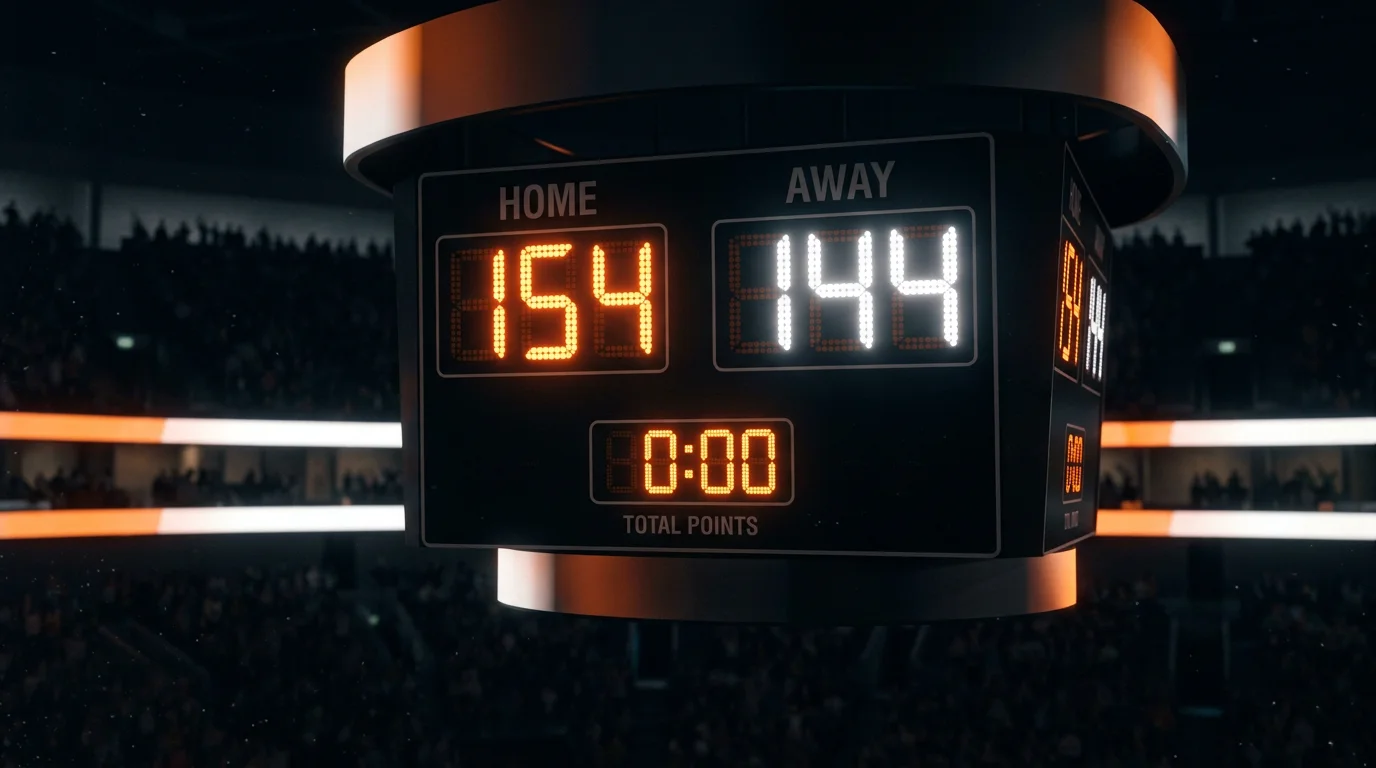
A few seasons back, two high-octane teams combined for 298 points in a single game — the kind of scoreline that makes sports headlines and immediately starts distorting how people bet on both teams for the next fortnight. I watched the totals on the following week of fixtures for those franchises balloon upward by five or six points, with bettors flooding to the over on the assumption that something fundamental had changed. It had not. It was an outlier, and the market had allowed an extreme result to override the longer-term data. The unders hit four out of five games. That is anchoring bias in its most expensive form.
Record-Breaking Games in NBA History
The NBA’s scoring records put modern totals in useful historical context. The highest-scoring game on record produced 370 combined points, when the Detroit Pistons defeated the Denver Nuggets 186-184 in triple overtime back in December 1983 — a game played in the era before the shot clock had fully transformed the pace of play into what it is today. Modern equivalents exist but at a different scale: games in the 270-290 combined point range now qualify as historically significant outliers.
What matters for bettors is not the records themselves but what happens to the market in the days following an extreme result. NBA teams across the regular season — which spans 82 games — have a well-documented tendency to revert to their mean pace and scoring rate within four to six games of an outlier performance. The statistical concept here is regression to the mean, and it is one of the most reliable and most consistently ignored phenomena in sports betting.
The average NBA game total in the 2024-25 season sits somewhere in the 225-230 range depending on the teams involved, pace matchup, and situation. When a specific game produces a combined 290, that is 60 or more points above the contextual average. The teams involved have not suddenly become permanently higher-scoring operations — they had an unusual game driven by factors that were situational: pace, foul rate, shooting percentage running hot, the absence of a defensive anchor. None of those factors reliably repeat in the next match-up.
Anchoring Bias and How Bookmakers Exploit It
Anchoring bias is the cognitive tendency to over-weight recently encountered information when making subsequent assessments. In basketball betting, it manifests as follows: you see a team score 155 points, and your mental baseline for “how much this team scores” immediately shifts upward. You start expecting 145-150 instead of the 112-115 that their season average and pace metrics actually suggest.
Bookmakers understand this bias and they use it. In the days following a record-breaking game, a trading team will often post totals a point or two above where pure analytical models would place them — not because they believe the inflated total is accurate, but because they know public money will disproportionately flow to the over. The inflated opening line attracts over-bettors, and the bookmaker profits from the margin on that action while adjusting the closing line back toward reality as sharp money pushes against it.
The practical implication: if you are looking at a game featuring a team that just produced or participated in a high-scoring outlier, be sceptical of any total that has been set five or more points above that team’s season pace-adjusted average. You are likely looking at an inflated opener designed to capture anchoring-biased public money. That does not automatically mean you should bet the under — but it does mean you should do the underlying arithmetic rather than letting the recent game influence your intuition.
The reverse version of this also occurs, though less dramatically. After a defensive stalemate — a combined 195 in a slow, foul-heavy game — public bettors often under-estimate the following games’ totals, anchoring to the low number they just watched. Bookmakers sometimes post unders at slightly inflated prices in these situations, knowing the public has been primed toward caution. Again: check the underlying pace data rather than the recent result.
Regression to the Mean and the Under Opportunity
Teams that have recently played in extremely high-scoring games cover unders at a meaningfully higher rate in their subsequent games. This is not a proprietary finding — it flows directly from basic statistical principles — but it is under-utilised by most UK bettors because acting on it requires overriding what feels like recent evidence.
The effect is strongest in the three to four games immediately following the extreme result, and it diminishes over the following two weeks as the outlier data point recedes in relative weight within the season sample. This creates a fairly defined window for the under approach: the game immediately after the record performance, and the one or two games after that, depending on the team’s schedule and opponent quality.
One important caveat: regression to the mean applies to the team’s performance, not to the total itself. If a team played in a 295-point game and their next opponent plays at a particularly fast pace with a weak defence, the underlying true total for that game might genuinely be 240-245. The regression effect does not override real matchup factors — it simply argues against inflating your expectation purely because of what you recently watched.
The framework I use: start from each team’s season pace-adjusted average scoring, apply the defensive rating of the opponent, and derive a baseline projected total. Then compare that to the bookmaker’s posted number. If the posted total is more than four points above my projection and I cannot identify a concrete reason for the discrepancy (injury to a key defender, for example), I look seriously at the under. After a record-breaking game, that gap is often there.
For a more detailed breakdown of how pace of play, defensive matchups, and situational context interact to produce accurate total projections, the full approach is covered in NBA game totals over/under strategy, which builds on these principles with specific analytical frameworks.
Do NBA teams keep scoring at the same level after a record game?
No — and the data consistently shows this. Record-breaking scores are produced by a combination of situational factors: unusually high pace, hot shooting percentages, foul rate, and opponent-specific matchup vulnerabilities. These conditions rarely repeat in the next game. Teams that participate in extreme scoring outliers tend to revert toward their season averages within three to five games, a process known as regression to the mean. Betting on sustained elevated scoring after a record performance has historically been a losing approach.
How should I adjust my total points bet after an unusually high-scoring game?
Start from the data rather than the recent result. Calculate a baseline projection using each team’s pace-adjusted season scoring average and opponent defensive rating, then compare it to the bookmaker’s posted total. If the posted number is significantly inflated above your projection with no clear explanatory factor (such as a key defender being injured), the under deserves serious consideration. The window where this edge is strongest is the first two to three games after the outlier performance.
Published by the Basketball Betting Strategies team.