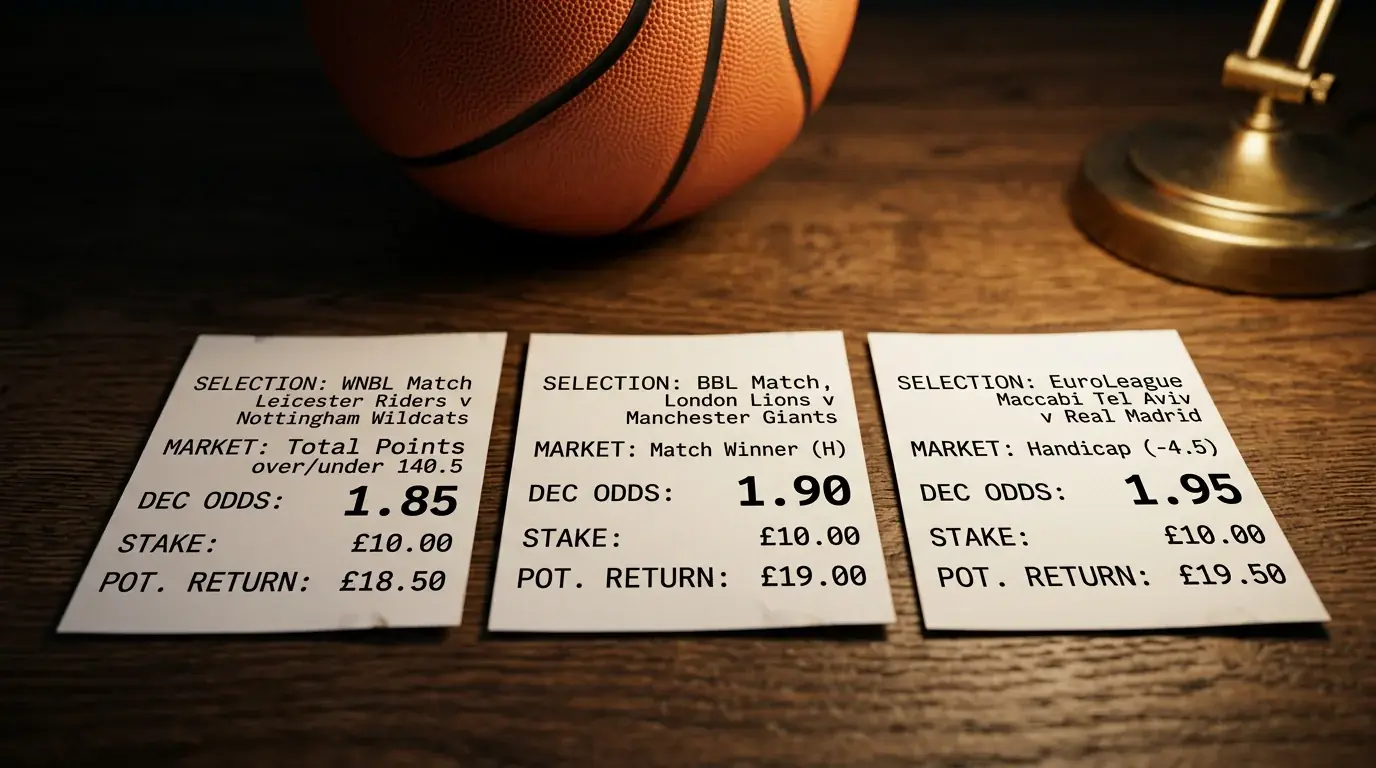
How to Read Basketball Betting Odds in the UK: Decimal, Fractional and American
 Available in US
The first time I tried to seriously research NBA betting strategy, I hit an immediate wall: almost every guide I found was written for American bettors. The odds were in moneyline format (-110, +240, -350), which meant nothing to me at the time. I spent an embarrassing amount of time puzzling over what “-110” even meant before I found a decent conversion chart.
That experience is nearly universal for UK punters getting into basketball betting. The NBA content ecosystem was built for an American audience, and the odds formats used in the United States are different from what UK bookmakers display by default. This guide is the one I wish I’d had in those early days: a clear explanation of all three formats, how they relate to each other, and — most usefully — how to convert between them without reaching for a calculator every time.
Decimal Odds: The UK Default
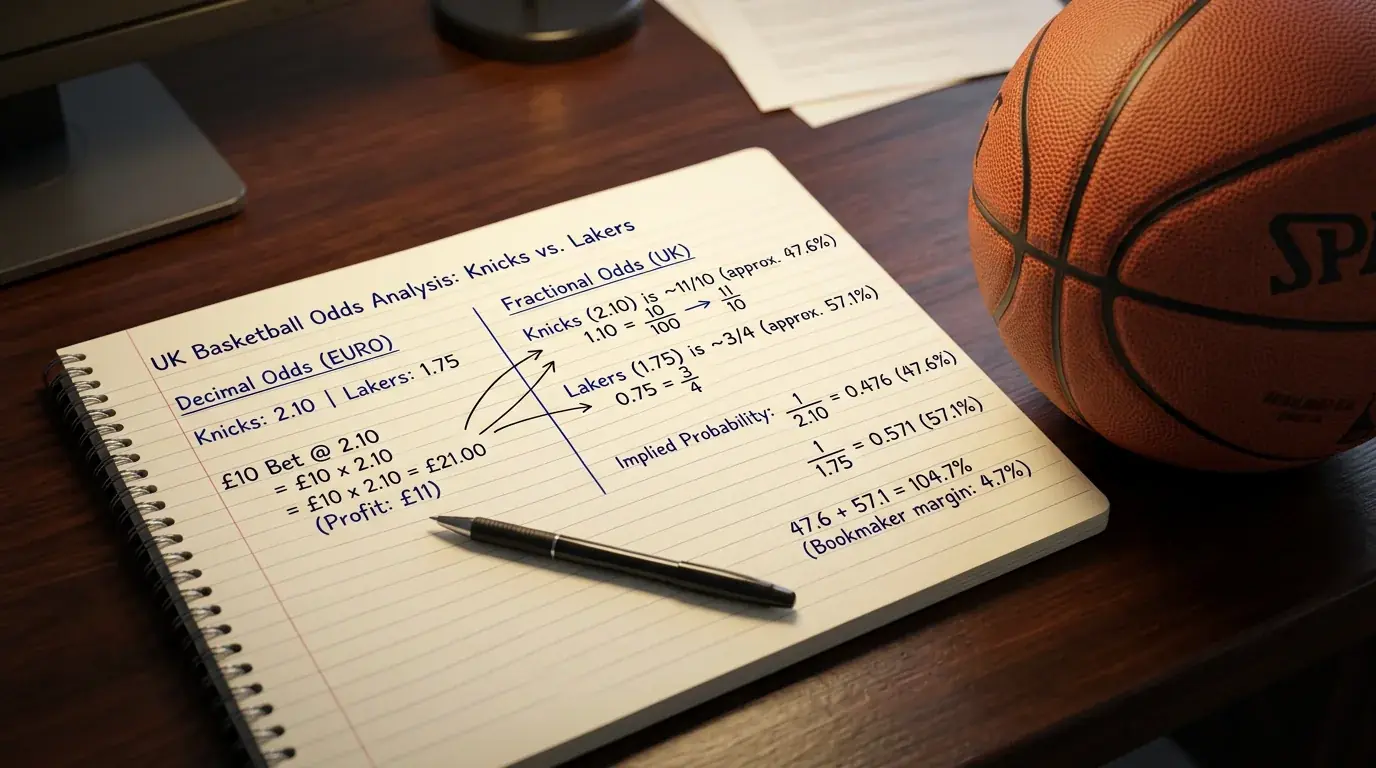
Decimal odds are the standard format at UK online bookmakers, and they’re the most intuitive once you understand the basic structure. The decimal number represents your total return per unit staked, including your original stake. So decimal odds of 2.00 mean you get back £2.00 for every £1.00 staked — £1.00 profit plus your £1.00 stake returned. Odds of 1.50 return £1.50 for every £1.00 staked, meaning £0.50 profit.
To calculate profit from a bet at decimal odds, the formula is: (stake x odds) – stake. A £20 bet at 2.40 decimal returns £48.00, of which £28.00 is profit and £20.00 is the returned stake. The bookmaker quotes the gross return; you subtract your stake to find the net profit.
Decimal odds make probability conversion extremely clean. Divide 1 by the decimal odds and you get the implied probability as a percentage: 1 ÷ 2.00 = 0.50 (50%). 1 ÷ 1.80 = 0.556 (55.6%). 1 ÷ 3.40 = 0.294 (29.4%). This calculation is the cornerstone of value betting — the ability to immediately convert any price you see into a probability statement. With decimal odds displayed by default at UK bookmakers, you’re one mental calculation away from the probability at any moment.
In the UK, decimal odds below 1.10 are occasionally displayed as fractions for readability, but the decimal format dominates for basketball markets. If a bookmaker’s NBA section shows 1.909 on both sides of a spread, that’s the UK equivalent of the standard American -110 juice on a spread bet. The fact that it shows as 1.909 rather than 1.91 or 1.90 is a sign that it’s a direct conversion from American moneyline format rather than an independently priced decimal line.
Fractional Odds: The Historical British Format
Fractional odds are the format that defined British bookmaking for over a century, and while decimal has largely taken over for online sports betting, fractionals still appear in some contexts — particularly in horse racing and at traditional high-street shops. Understanding them is useful because some basketball content still references this format, and occasional bookmakers still display it as an option.
The fraction tells you how much profit you make relative to your stake. Odds of 2/1 (read as “two-to-one”) mean you profit £2.00 for every £1.00 staked. Odds of 5/4 (“five-to-four”) mean you profit £5.00 for every £4.00 staked — or equivalently, £1.25 for every £1.00. Evens (written as EVS or 1/1) means you profit exactly as much as you stake.
To convert fractional to decimal, divide the numerator by the denominator and add 1. Odds of 2/1 become (2 ÷ 1) + 1 = 3.00 decimal. Odds of 5/4 become (5 ÷ 4) + 1 = 2.25 decimal. Odds of 4/6 (a favourite) become (4 ÷ 6) + 1 = 1.667 decimal. Once you’ve converted to decimal, you can apply the standard implied probability calculation from there.
For betting on the NBA specifically, you will almost never need to use fractional odds unless you’re actively choosing to display them as a preference in your bookmaker’s account settings. Decimal is the default and the more practical format for basketball.
American Odds (Moneyline Format): The NBA Native Format
American odds use a system built around a base unit of £100, and they come in two forms: positive numbers (indicating an underdog) and negative numbers (indicating a favourite). The UK regularly handles around 290 million online bets per month, and a significant portion of basketball research those bettors rely on was written using this format — so understanding it is genuinely practical.
Negative moneyline odds show how much you need to stake to profit £100. Odds of -150 mean you stake £150 to profit £100. Odds of -110 (the standard spread bet juice in America) mean you stake £110 to profit £100. Odds of -300 mean you stake £300 to profit £100. The bigger the negative number, the bigger the favourite.
Positive moneyline odds show how much you profit for every £100 staked. Odds of +200 mean a £100 stake returns £200 profit. Odds of +350 mean a £100 stake returns £350 profit. Odds of +120 mean a £100 stake returns £120 profit. The bigger the positive number, the bigger the underdog.
Converting American odds to decimal takes one formula for each type. For negative odds: decimal = 1 + (100 ÷ |negative number|). So -110 becomes 1 + (100 ÷ 110) = 1.909. -150 becomes 1 + (100 ÷ 150) = 1.667. For positive odds: decimal = 1 + (positive number ÷ 100). So +200 becomes 1 + (200 ÷ 100) = 3.00. +350 becomes 1 + (350 ÷ 100) = 4.50.
A Quick Reference Conversion Table
These conversions cover the range you’ll encounter most frequently in NBA betting research and on UK bookmaker platforms.
American -110 equals decimal 1.909, implied probability 52.4%. American -120 equals decimal 1.833, implied probability 54.5%. American -150 equals decimal 1.667, implied probability 60.0%. American -200 equals decimal 1.500, implied probability 66.7%. American +100 (evens) equals decimal 2.000, implied probability 50.0%. American +120 equals decimal 2.200, implied probability 45.5%. American +150 equals decimal 2.500, implied probability 40.0%. American +200 equals decimal 3.000, implied probability 33.3%. American +250 equals decimal 3.500, implied probability 28.6%.
Once you’ve internalised that -110 is 1.909 and +100 is 2.00, most other conversions become quick mental arithmetic. The real payoff from understanding all three formats is the ability to read American strategy content and NBA analysis without losing track of what the numbers mean — which dramatically widens the quality of information you can draw on for your betting decisions. If you want to build on that foundation and understand how to assess whether any of those prices represents genuine value, the guide on NBA value betting strategy goes into implied probability and closing line value in practical detail.
The Bookmaker Margin Across All Formats
One thing that the format of odds doesn’t change is the bookmaker’s margin — the built-in edge that exists regardless of whether prices are expressed in decimal, fractional, or American format. The margin is the difference between the true probability of all outcomes adding up to 100% and the implied probability from the odds actually offered adding up to more than 100%.
On a standard NBA spread bet at a UK bookmaker, you typically see both sides priced at 1.909 decimal (equivalent to -110 American). The implied probability of 1.909 is 52.4%. Two sides at 52.4% add up to 104.8%, meaning the bookmaker has a 4.8% built-in margin on the bet. You need to win more than 52.4% of your spread bets at these odds just to break even — not 50%, as a naive reading of “equal odds on both sides” might suggest.
The margin varies by market type and by bookmaker. Spread bets tend to have margins of 4% to 8%. Outright markets and futures carry higher margins, often 10% to 20%. Understanding this is why value betting — finding prices where your probability estimate exceeds the implied probability by enough to overcome the margin — is the only sustainable path to long-term profitability.
Why do most NBA betting articles use American odds when I am in the UK?
The vast majority of NBA betting strategy content is produced by American writers for American audiences, where the moneyline (American odds) format is the industry standard. Because the NBA itself is an American product with most of its data infrastructure, media coverage, and analytical community based in the United States, the content follows that audience. For UK bettors, the practical solution is to learn how to convert American odds to decimal, which takes a simple formula and becomes second nature quickly.
How do I convert American moneyline odds to UK decimal?
For negative American odds (favourites): decimal = 1 + (100 divided by the absolute value of the odds). So -110 becomes 1 + (100/110) = 1.909. For positive American odds (underdogs): decimal = 1 + (odds divided by 100). So +200 becomes 1 + (200/100) = 3.00. Memorising the most common conversion — that -110 equals 1.909 decimal — handles most spread bet scenarios, and from there the pattern for other values becomes straightforward.
Published by the Basketball Betting Strategies team.